At any given time, over two billion people around the world are actively menstruating, but like anything, access to period products are dependent on a person’s social status. In the United States, 1 in 4 teens experience period poverty — the inability to access or afford menstrual products.
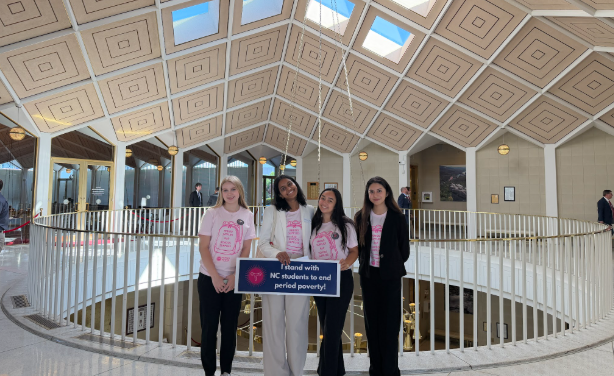
A group of students, rallied by the NC Diaper Bank’s Period Power Coalition, went to the North Carolina General Assembly on May 19, 2026, to advocate for the need to add free period products in schools. This day was named Period Advocacy Day, reclaiming “period” as a word of power instead of a word that brings embarrassment and shame to a teenage menstruator.
In the current North Carolina budget, $500,000 is being delegated to the Department of Public Instruction (DPI) through the Feminine Hygiene Grant Program. DPI currently funds menstruation products for 164 schools across the state. To receive this funding, a school must apply for it; however, this money is in such a high demand that the application is only open for a couple days, leaving many schools in rural counties or unknowing of the grant in the dark.
In contrast, the NC Diaper Bank, without any state funding, currently serves over 1000 schools. They have established bulk buying relationships with period product companies. If the $500,000 from the Feminine Hygiene Grant Program was simply redirected from DPI to the NC Diaper Bank, over 1000 additional schools would be able to receive funding. The NC Diaper Bank has already implemented an efficient use of funds; they are simply looking to expand a pre-existing program.
The NC Period Power Coalition took this mission and worked for a month prior to Period Advocacy Day
Over the course of eight training sessions, student advocates built connections with each other, sent outreach emails to North Carolina representatives, utilized social media, and developed their public speaking skills.
I was one of 22 youth advocates present at the general assembly in May addressing the Feminine Hygiene Grant Program. We split up into five different advocate groups to connect with over 30 legislators in just a few hours.
Each member of the Period Power Coalition was given a pale pink t-shirt that said “Period Supplies are School Supplies”. It was a sign of unity, strength, and a way to spread the mission statement to people just walking down the halls.
I personally attended nine meetings with various legislators from across the state with the following people:
- Representative Cynthia Ball, Wake County
- Representative Becky Carney, Mecklenburg County
- Representative Morey’s Legislative Assistant, Durham County
- Representative Phil Rubin, Wake County
- Senator DeAndra Salvador, Mecklenburg County
- Senator Dan Blue, Wake County
- Senator Paul Lowe, Forsyth County
- Senator Jay Chaudhuri’s Legislative Assistant
- Senator Lisa Grafstein, Wake County
Some meetings were as casual as sitting in lobby lounge chairs. Some meetings were formally sitting in an office with stiff interns in the corner furiously taking notes. Yet one thing was common across the board; the Period Power Coalition got an overwhelming amount of support.
Every legislator took time to praise the power of student voice. The goals of the meetings were to remind them of the younger demographic that they serve. We wanted to give them a face to young girls that are truly affected by period poverty.
In each meeting, 3-5 young advocates would take turns expressing their gratitude to the legislator, share their personal experience with period poverty, and explain why the $500,000 from the Feminine Hygiene Grant was so important.
One of my most notable meetings was with Representative Rubin from Wake County. Representative Rubin has a young daughter that goes to Leesville Elementary. Since he understood my community, it was easy to explain how the demographics of our school were affected by period poverty.
One of the reasons this meeting stuck out to me was because I learned about the process of creating a budget. Now, as a smaller member of the minority party, Representative Rubin is not in charge of approving the budget, or even putting things in the budget, but he spoke of the need to talk to as many legislators as we could to make it a bipartisan issue.
North Carolina’s budget process has a few major steps. After reviewing state agencies budget needs and expensive proposals, the Governor recommends a budget. Then, the General Assembly will debate and pass a budget in appropriations act — an fancy legislative measure that allows the government to withdraw funds from the public treasury. It is at that time that the Governor has power to sign the budget into law or veto it and send it back into a General Assembly debate.
Period Advocacy Day happened in between the legislative negotiation and the Governor’s approval phase of creating a budget. Advocates from the NC Period Power Coalition can only hope that their efforts ensure an efficient use of $500,000 to help young women across the state access health necessities.
It makes my day better when people bring me Chipotle.
Leave a Reply