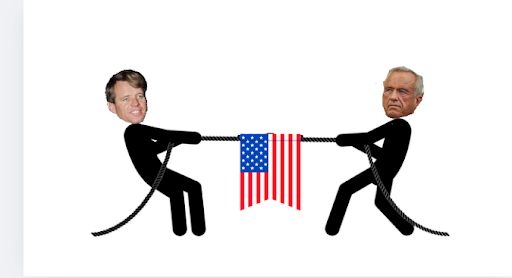
While their careers were separated by half a century, father and son share a distinct political DNA: a willingness to challenge the establishment and a penchant for framing themselves as outsiders fighting for the forgotten.
However, the nature of their rebellions could not be more distinct: the father channeled his dissent into reshaping the Democratic Party and championing the civil rights and anti-Vietnam War movements from the Senate. The son has positioned himself outside the traditional realm of politics and led a charge against science, vaccine policies, food and chemical regulation, and the influence of the pharmaceutical industry.
RFK Sr. sought to redeem the system’s broken promises; RFK Jr. has built a platform largely defined by his skepticism of the system’s very integrity.
Robert Francis Kennedy was born in 1925 to influential investor and diplomat Joseph Kennedy. He and his brothers, future president John and future senator Ted, would serve in the military before going on to have highly successful political careers.
Robert Kennedy’s rebellion was unique because it came from the ultimate insider. As a former Attorney General and a sitting U.S. senator, he understood the levers of power better than anyone in America. Yet his 1968 presidential campaign was that of an insurgent championing the unempowered.
RFK Sr. did not seek to destroy the government. He sought to force it to live up to its moral obligations. He viewed the ‘enemy’ not as the institutions themselves but the indifference within them. His populism was built on a “coalition of have-nots”. Uniting Black Americans, rural whites, Latinos, and the young, he demanded that the Democratic Party return to its roots.
He believed that with the right leadership, the Department of Justice, the welfare state, and the American military could be forces for the betterment of society. His political rebellion was one of faith in the American ability to rebuild.
RFK Sr. was pivotal in many movements during the 60s. He worked with MLK throughout the Civil Rights movement. Though he did approve the surveillance and phone tapping of MLK, it was under the pressure of J. Edgar Hoover. His perceived lack of pushback on the measure would haunt the rest of his political career.
Robert Kennedy’s work with the civil rights movement did not go unnoticed; however, the day after MLK’s assassination, many major cities saw widespread riots. Indianapolis was one city that saw little to no violence. This was in part due to the speech Kennedy gave, in which he announced King’s death and sought to console and unite the crowd gathered in hopes of continuing the just cause for which King had just become a martyr.
RFK, primarily posthumously, was also a major rallying figure for the anti-Vietnam War movement and the subsequent ‘New Left’. Students for a Democratic Society was a prominent organization that led anti-war protests at Berkley and the 1968 Democratic National Convention, led by Tom Hayden. The Kennedy family chose Hayden to be an honorary pallbearer because of the quiet friendship they had formed and the hope both men shared for the future of America.
He also worked closely with Cesar Chavez and the migrant worker movement. After he met the labor leader, one of Chavez’s associates said, “Robert didn’t come to us and tell us what was good for us. He came to us and asked us two questions: ‘What do you want?’ And ‘How can I help?’ That’s why we loved him,”.
In contrast, Robert F. Kennedy Jr.’s rebellion is defined by a profound loss of faith in those very institutions. While he began his career using the court system to hold polluters accountable—a traditional form of advocacy—his political identity shifted toward a view that the “machinery” itself is broken beyond repair.
The bridge between RFK Jr’s past and present lies in his environmental roots. Long before he was a health skeptic, RFK was a celebrated environmental attorney who spent decades suing corporate polluters like Monsanto and DuPont for hiding toxicity data to protect their bottom lines.
His psychological shift occurred when he applied that same legal theory– that corporations lie to protect profits– to the pharmaceutical industry. While the father viewed the government as a shield against corporate greed, the son came to view the government as a partner in it, arguing that the same “agency capture” he fought in the EPA had corrupted the FDA and CDC
RFK Jr.’s modern populism targets what he calls “agency capture,” the theory that regulatory bodies (like the FDA or CDC) are under the control of the same corporations they are meant to regulate. He bases this claim by pointing toward the payments these companies make for an expedited approval process by the FDA through something called User Fees. These allow companies to partially or fully fund the FDA’s approval process for their own drugs.
From this distrust, RFK Jr. has constructed a new coalition of those distrustful of the modern medicine industry, distinct from his father’s coalition of “have-nots”. Where Robert Kennedy toured the Mississippi Delta to rally the economically impoverished, RFK Jr. rallies the metabolically compromised, at least those disillusioned with modern science, framing the “chronic disease epidemic”, from autism to obesity, as the defining crisis of the modern era.
Under the banner of “Make America Healthy Again,” he argues that a symbiotic relationship between “Big food” and Big Pharma has poisoned the American public. In his view, the “forgotten man” is no longer just the worker left behind by the economy, but the child left sickened by the food and drug system.
This rebellion, however, has come at a steep personal cost: the fracturing of the very dynasty his father built. RFK Sr. was the glue that held the Democratic coalition; he was key in energizing the black vote, which grew wary after the assassination of MLK, and was courted by the New Deal. Along with helping hold the Kennedy family together after the death of JFK, RFK Jr.’s insurgency has exiled him from both.
While his father died a martyr to the party’s ideals, the son has been publicly denounced for his collaboration with Donald Trump and his various medical conspiracies. It is the ultimate tragedy of his rebellion: in attempting to claim his father’s mantle as a “truth-teller,” he burnt down the house his father helped build.
It makes my day better when my hair isn’t a mess when I wake up.
Leave a Reply