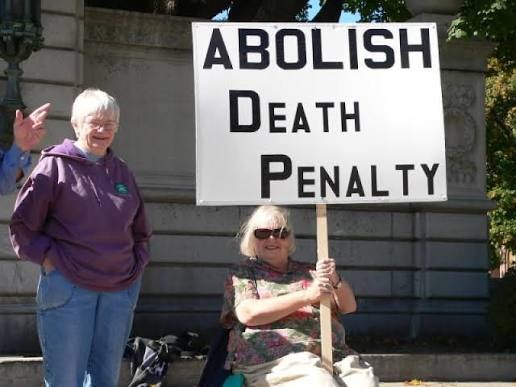
An older woman holds a sign calling for the death penalty to be ended. Her message shows the strong debate over whether the death penalty should still be used. (Photo courtesy of Creative commons)
The death penalty has been debated in the United States for years. Some people believe it is a fair punishment for people who commit the most serious crimes. Others believe the government should never have the power to take someone’s life. Recent cases involving Christa Pike and Nidal Hisan have brought the debate into the spotlight, especially after President Donald Trump approved a military execution by firing squad.
The death penalty, also called capital punishment, is when the government sentences a person to death for a serious crime. It is currently legal in some U.S. states, as well as under federal and military law. Supporters say it can give justice to victims and their families. They also argue that some crimes are so serious that the person responsible deserves the strongest possible punishment.
People against the death penalty see things differently. They argue that killing someone as punishment is wrong, even when that person committed a terrible crime. Another major concern is that the justice system can make mistakes. If someone is executed and later proven innocent, there is no way to undo the punishment.
One of the most recent cases raising questions about the death penalty is Christa Pike’s case in Tennessee. Pike was sentenced to death for the 1995 murder of 19-year-old Colleen Slemmer. Pike was 18 years old when the crime happened. Her lawyers argued that her difficult childhood and mental health history should have received more attention during her original sentencing. The U.S. Supreme Court allowed Tennessee to move forward with her execution on September 30, 2026.
However, the execution did not go as planned. Pike survived the lethal injection and was taken to a hospital. Her lawyers said she later regained consciousness. Tennessee officials have since suspended the state’s remaining executions for 2026 while the state investigates what happened.
Pike’s case has started another discussion about whether executions can ever be carried out in a way that is completely reliable and humane. Supporters of the death penalty may see the failed execution as a problem with the way the punishment was carried out, rather than a reason to end the death penalty itself. Opponents argue that the incident shows how serious the risks are when the government tries to carry out an execution.
Another major case is Nidal Hasan, the former U.S. Army psychiatrist who was convicted of killing 13 people and injuring more than 30 others during the 2009 Fort Hood shooting in Texas. Hasan was sentenced to death by a military court in 2013. He admitted that he was responsible for the shooting during his trial.
On October 6, 2026, President Trump approved Hasan’s execution. The military plans to use a firing squad, and the execution is on December 3. If it happens, it would be the first U.S. military execution since 1961. Hasan could still use the appeals process to try to delay the execution.
The Hasan case is especially important because of the method being used. Earlier this year, the Trump administration directed the federal government to expand the methods it could use for executions, including adding the firing squad. The Justice Department also brought back a lethal injection system used during Trump’s first term.
Firing squads are rare in the United States. Only a small number of states allow them, and they have been used only a few times in recent years. The federal government’s decision to consider more execution methods shows that the death penalty is still an important issue under the current administration.
Supporters of the death penalty say cases like Hasan’s argue why capital punishment should remain available. They point to the number of people killed and injured and argue that some crimes are so serious that life in prison is not enough punishment. They also believe the death penalty can give victims’ families a sense of justice and closure.
Others say the death penalty does not always bring families closure. Death penalty cases can also take many years because of appeals, keeping families connected to the case.
Cost is another issue. Death penalty cases can cost more than life in prison because of long trials and appeals. Some people also worry that an innocent person could be executed.
Cases like Christa Pike’s and Nidal Hasan’s make the debate even harder. Pike’s failed execution raised questions about how executions are carried out, while Hasan’s planned firing squad has brought attention to the use of that method again.
The debate will continue. Some believe certain crimes deserve the death penalty, while others believe the government should never take a person’s life. The bigger question is whether the death penalty is really the best way to deliver justice.

Leave a Reply