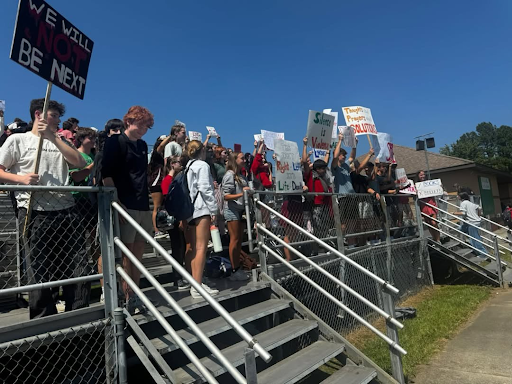
The goal of any protest is to cause change, but neither of the protests at Leesville have been successful at causing any change relevant to the school or community. The reason for this becomes clear once looking at the causes for the previous two walkouts: protests against gun violence. This is a noble cause, but it is not a cause that is relevant to Leesville.
High school protests that have caused major change usually happen as a result of an event in their school. According to The Cypress, one notable success for school activists was an incident at a high school where a Dean pulled black students from class after a racist video circulated online in an effort to find a way to handle the situation. The students protested and forced the Dean to issue an apology for his action.
Student leaders should take note of why the protest forced an apology from a Dean: they focused on a smaller scale, school level issue that can actually be fixed through protesting.
Gabriella Franco, junior said, “Say there’s like a gross, messed up teacher, and they all want him fired, then the students could come together and go against it.” The problem is, this is the opposite of what current Leesville protests are doing.
Instead, they are focusing on a national level cause. When asked what cause could benefit students, Eli Singer, junior, first thought of an issue directly relevant to students: “Getting the vending machines to work, first off,” he said.
There are many issues with current Leesville protests that need to be fixed. As I mentioned, they focus on causes that are not directly relevant to the school. The protests lack of relevance to students leads to an even bigger issue: student apathy. “I wanted to go, so I could skip class,” said Seamous Cullen, junior. If a protest’s cause is not relevant to students, students will only see a protest as an excuse to skip class.
Students only attending to skip class is causing some students to believe that walkouts don’t have any lasting effect. Betania Metaferia, junior, said, “If the walkouts didn’t happen, nothing would change. Everything would be the same.” The issue is that she isn’t wrong. Leesville students have not seen their activism lead to change in their daily lives, so they grow to view activism as a pointless activity that doesn’t cause change.
Some students even wonder if the organisers truly care about the causes they protest. Cullen said, “That just looks good on a college essay and it takes thirty minutes and doesn’t do anything.”
Max Douglas, junior, held a more neutral view. “I think it probably is a bit of both, but I think the intentions of the people that organized it were probably better than some of the people who just did it to get out of class.”
So how can Leesville fix this? The biggest way to cause change is to protest causes that are directly relevant to Leesville students daily lives, or a Leesville specific issue. Realistically speaking, protests for or against national issues are a waste of time and arguably are performative activism, on both the organizational and attendee side.
Students are much more likely to actually care when the cause is relevant so this alone fixes most of the issues.
To the school’s credit, it has handled previous protests well. According to The Hill, 60 percent of parents believe that schools should allow students to conduct walkouts, but 48% of those parents believe that the school should only allow students to protest under adult supervision.
In addition, most parents do not want schools encouraging their children to protest. Leesville has done well to abide by these wishes, doing exactly as the poll would suggest.
So far, Leesville’s protests have been very organized and have never compromised student safety. According to the poll that The Hill published, student safety was parents’ biggest concern.
Leesville’s protests have been orchestrated well in the past, but now student leaders need to consider the best causes to protest, in addition to conducting it in a safe manner that brings in as many students as possible.
There is no denying that protests against gun violence or broader national issues can be noble, but if students truly want to make change, they need to protest something local or a school centered issue.

Leave a Reply