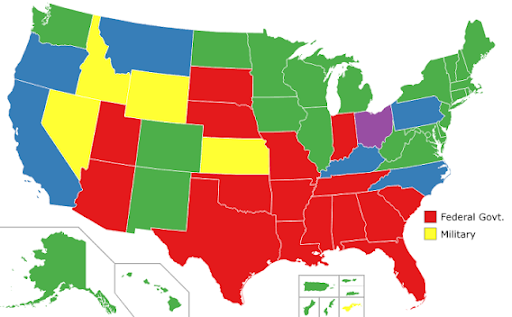
The death penalty is one of the most polarizing issues in the United States today. There’s currently 11 more executions scheduled for 2026 and 38 scheduled for the next 4 years. In North Carolina, the death penalty remains legally authorized for first-degree murder cases.
To the majority of high school teens, the death penalty seems unthinkable. However, prior to the 2005 Roper v. Simmons’ case, the death penalty was legal to juveniles at the same age my peers and I are right now.
The Supreme Court’s ruling in Roper v. Simmons affected 72 juveniles in 12 states. All scheduled to be executed in the next 7- 25 years. The hard truth is that these children with the same brain development I have were sentenced to death by lethal injection.
These condemned juveniles constituted about 2% of the total death row population. While high school students like me are navigating tests, sports, and planning for our future, these youth are facing the very end of their life. At the resolution of Roper v. Simmons, Justice Kennedy, writing for the majority (Kennedy, Breyer, Ginsburg, Souter, and Stevens, JJ.) said, “When a juvenile offender commits a heinous crime, the State can exact forfeiture of some of the most basic liberties, but the State cannot extinguish his life and his potential to attain a mature understanding of his own humanity.” His statement resulted in the end of all execution of convicted minors.
Prior to the case it had been argued that any crime committed that condemns a person to capital punishment, no matter the age, deserves the punishment. The majority of people thought that a just society requires the taking of a life for a life. From the point of view of the victim and their family, it’s strongly viewed that the severity of capital crimes demands an equal measure of punishment. While victims’ families deserve lots of compassion and support, it is important to look past immediate vengeance and see that executing people does not give justice or fix the crime. Though carrying out an execution may seem comforting, to get revenge on what seem to be horrible and deeply disturbed people, in reality it only leads to further trauma.
However, the death penalty has been abolished in 23 U.S. states and Washington D.C. and for most states where the death penalty is still allowed, an execution hasn’t been carried out in years.
Most issues with the death penalty are because it conflicts with most moral and religious views. Catholics, and most religious faiths, consider killing evil, so why would we allow state sponsored killing? For Christians there are the OT commandments plus Jesus’s ultimate commandment to love God with all your heart and love your neighbor as yourself. Each religion has a different teaching on killing, but there isn’t many religions that are for executing people/
Another problem is handling the inequities of the justice system. Due to biases, such as racial bias, not everyone receives the same sentence and people on death row have been found to be not guilty. Although some wrongfully convicted have been exonerated, the truth is many are executed or die in prison waiting to be executed. Since 1973, at least 200 people have been exonerated from death row in the U.S., according to the Death Penalty Information Center (DPIC). A 2014 study on the rate of false conviction estimated that at least 4% of those sentenced to death are innocent.
Is the chance of killing a completely innocent person worth the “justice” given by killing the guilty?
Carrying out executions hurts everyone involved. Most people think about the ones dying, but it’s important to think about the people in charge of killing them. The people who work in the execution teams carry trauma, too. Former executioner, Ron Andrew, talks about one of his botched executions “It was horrifying and something I’ll never forget …by the time I left the prison system, I had started drinking a lot in order to sleep as I was having a lot of nightmares. I was buying Scotch by the case.” A large majority of former executioners suffer from PTSD and many have eventually spoken out against the death penalty.
The death penalty forces us to decide if a person’s worst mistake should define whether or not their life is worth anything. By taking away the chance for someone to grow, learn, and make amends, we give up on the idea that people can ever change for the better. A justice system that values life cannot justify taking it. Real justice requires fairness, empathy, and the recognition that every human life is valuable.
Leave a Reply