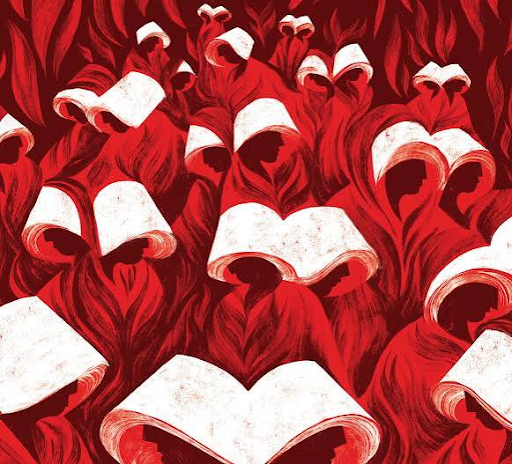
The Handmaid’s Tale by Margaret Atwood is a dystopian novel that follows the main protagonist, Offred, through her journey finding power in a new social hierarchy. The book incorporates harsh but important topics such as sexual assault, discrimination, and enslavement.
It takes place in a futuristic timeline where environmental disasters cause low birthrates. Offred, our main character and narrator, is a Handmaid. Her sole purpose is to get pregnant and give birth successfully.
The book takes place in Gilead, a society and government that has taken over the United States. Before the new government system took over, Offred used to live in Cambridge, Massachusetts, specifically around Harvard University. This new society is organized into strict social classes, with men holding all political and social power. Gilead uses religion, fear, surveillance, and punishment, all disguised as “The Eye”, to maintain control.
The book is short, only a little over 300 pages depending on the version. Atwood introduced the world and authoritarian system quickly, allowing me to easily immerse myself in the story. Gilead is far-fetched enough for the novel to be dystopian and entertaining – but it still has themes and ideas from the real world that snap the reader back to remembering the message the Atwood is trying to deliver.
Atwood’s writing style is blunt and straightforward but also beautiful. She could spend two pages talking about one idea, or just one sentence, but both left me taking a moment to reflect. She puts feelings and concepts into words in a way that not many authors are capable of doing.
She discusses topics such as death, grief, and love in ways that made me think, “Why didn’t I think of it that way before?” This novel made me reconsider the way I think about things like love and grief, especially when they come or go in a way I can’t control, like they did for Offred.
The Handmaid’s Tale changed the way I view my day to day life. The novel forced me to look at normal things in a new light. Offred had a life and a family prior to the new society. Throughout the book, she would reminisce on the clothes she wore or the things she could say without a second thought in the “time before”. Now, Offred is under strict regulations and parameters from the government. It made me appreciate little things that I may overlook, like going to the beach or a school dance, but for Offred, they are no longer a reality.
There is lots of significant symbolism throughout The Handmaid’s Tale. “The Wall” is a large concrete wall surrounding what was once a university, assumedly Harvard University. On the wall hangs the bodies of traitors or criminals. Both men and women who have disobeyed the government are left to hang publically – it is a tactic of fear and intimidation for anyone who may pass by.
The Wall is also a symbol of the barrier put around knowledge and power in Gilead. The university now serves as a central location for authoritarian control and surveillance in the town. The building is no longer a place to learn and grow, but instead a place to control the people. The Wall is both a physical and metaphorical barrier put around the chance of knowledge and any form of power for women in the society.
Access to education in modern times is vast and available to anyone. The way Offred yearns for simple information in the novel makes me appreciate the opportunities I have to continue my education, and the choices surrounding it.
Atwood uses the internal humor of Offred to lighten hard topics. Offred was once a regular woman and mother, and now she is trapped behind a red cloak and white hood. Her inner monologue is important in developing her character, as well as giving the reader context and backstory from her “past” life.
There are many other characters used to lighten the mood as well. Moira, Offred’s best friend, is a rebellious and defiant character. She is sarcastic and light hearted, always making Offred feel better in a difficult situation. Foil characters like Moira are important to the development of Offred’s character in particular, because they highlight the difference between their rebellion and her obedience.
The Handmaid’s Tale is a brilliant modern classic. It showcases important topics in a way that is comprehensible for someone who isn’t familiar with them. Novels like The Handmaid’s Tale are not required in a lot of schools, but without them, people grow up oblivious to things that real people experience in our world. Atwood demonstrates the duality of women, and the importance of understanding all sides of them.

It makes my day better when I park well.
Leave a Reply