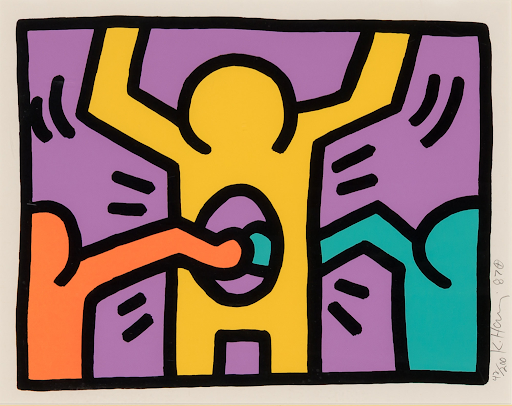
With art comes emotion and identity. Artists often create what they think, and what they are feeling. Art allows people to express their emotions and bring them onto a piece of paper.
Art reflects your imagination. It allows you to take something considered a dream, and share it. Different mediums can be used to do this, such as watercolors, pencils, or crayons. These mediums can help artists express what they want.
Rachel Fuller, senior, said, “In art one, I feel like I was kind of messing around, discovering what mediums I liked. Then as I continued going through art, I discovered that I really liked acrylic paint, and that’s what I’m really good at now.”
The colors, mediums, and symbols you use can all affect how your art comes across. For example, lots of greys and gloomy colors like dark greens and blues can express an emotion of sadness. Whereas bright colors like yellows, pinks, and orange come across as an exciting piece of art.
Symbols also impact how your art comes across.If you see frowning, or a person crying, etc, you assume the artwork is an upsetting piece of art.
Color theory has been around for a long time. Artists have used color intentionally to express emotions throughout history. On Renee Philips’ website, we learn how different artists perceive colors and how they impact people. Renee Phillips wrote, “O’Keeffe was aware that using opposite colors — shades of red and green — serve to express power and contrast, while analogous colors –red against purple and blue with green — create passages of quiet and calmness.” Similar to other artists, O’Keeffe understood how to include primary, secondary, and tertiary colors that complement each other to create a feeling through the artwork.
According to the “All About Psychology” website, “Studies using fMRI have shown strong activity in the default mode network, the same system we use when daydreaming, remembering, or imagining the future. This suggests that art does more than please the senses; it draws us into ourselves. It connects what we see with who we are.” When you see a piece of artwork, many people have a different reaction to it, based on if you have a connection to the artwork or not. Some may find it beautiful because they understand it, but some it may not be meaningful.
In art, it’s not about knowledge because it reflects your emotions and identity. This makes art for everyone personal and one of a kind.
Fuller said, “When I draw, I put my emotion into it. I will put on music and channel an emotion to really zone into my art.”
Emotion is something that everyone experiences daily, but many don’t understand all of their emotions. A healthy way for people to express their emotions, even the ones considered bad like sadness or anger is art. If people find it tricky to talk about their emotions, they can try putting them on a piece of paper, rather than focusing on talking.
Madison Watson, senior, said, “Sometimes when I feel like I can’t share something with others, I just put it in my art and it helps me calm down, or makes me feel better.” Sharing your feelings isn’t always easy, but a way that you can still voice your emotions is by creating art. This allows you to express your emotions, without sharing them if you don’t want to.
Studies also prove that art can help with depression and anxiety. “Psychology today” reports, “Repetitive satisfying art making may actually mediate depression and anxiety by stimulating the ‘accumbens-striatial-cortical’ connection in the brain. It is perhaps connected to what psychologist Mihaly Csikszentmihalyi named ‘flow,’ an experience of complete concentration and absorption.” Since art connects to the brain, repetitive art specifically is able to calm you down. For example, when you use a coloring book or stencils, you tend to feel more relaxed after coloring.
In the article, The History of Art Therapy, mention how art therapy was originally made for patients dealing with tuberculosis. It reads, “The formal practice of art therapy has its origins in the mid-20th century Europe, with the coining of the term being attributed to British artist Adrian Hill in 1942. At a time where thousands suffered in sanatoriums from tuberculosis, it was observed that drawing and painting was a creative outlet for patients that provided them the freedom their confines did not.” Even though art therapy’s origin was for patients with tuberculosis, it began to spread to mental hospitals, and around the world.
Sydney Champion, senior, said, “I feel like a lot of the art that I draw brings back so many memories that I tend to forget.” When creating, art can bring back memories and nostalgia. Psychologists call this involuntary memory retrieval. Involuntary memory retrieval is where you remember something from your past through a smell, a song, or a food. In the case of art, it can be textures, colors, or shapes.
Champion said, “Right now we are doing white and black art, I’m doing a graveyard, so that kind of reminds me of my grandma.”
For Champion, the involuntary memory retrieval process may have happened from working with a black and white color scheme. Black and white art often gloomy, which could have brought these memories back.

Leave a Reply