On February 28, 2026, the United States launched ‘Operation Epic Fury,’ inciting an ongoing war with the nation of Iran.
The initial US attack on the country killed Ayatollah Ali Khamenei, the nation’s supreme leader for decades. At least 175 other individuals, mostly children, were killed when a missile struck an all-girls school in southern Iran, according to The New York Times.
As retaliation, Iranian leaders made moves to close the Strait of Hormuz. The Strait is a critical oil shipping route that connects the interior of the Persian Gulf–which hosts the world’s largest proven oil reserves–to the Indian Ocean.
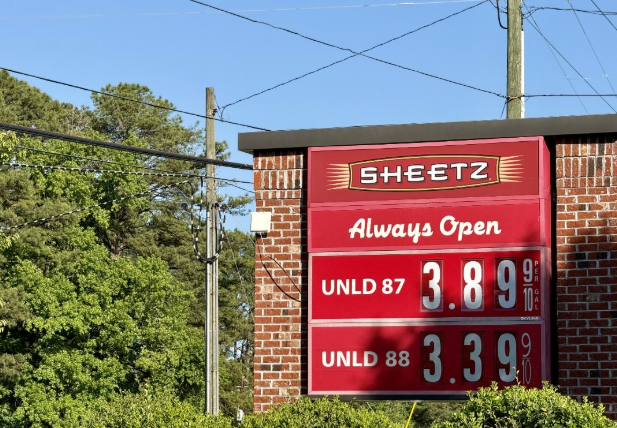
Gas prices have skyrocketed since the war started, due to the closure of the Strait of Hormuz. The effects of these prices have been widespread at home and have affected many aspects of our daily lives.
Nearly everything we Americans rely on relies on oil in some way, shape, or form. Nearly every form of transportation uses oil, and as transportation costs rise, the cost of everything else rises with them.
One major non-oil commodity experiencing rising costs is groceries, with many transportation-heavy goods such as dairy and out-of-season produce seeing a rise in prices.
Yet the cost of driving overall has taken a major hit on everyone, especially us students. Pre-war prices hovered around $2.90 per gallon for regular gas, making transportation available to most working individuals. A barrel of oil pre-war was hovering around $70, while post-conflict prices are nearing $117 (as of 4/30).
As of May 6th, 2026, average national gas prices are hovering around a whopping $4.54 per gallon, meaning a tank of gas that would’ve cost $45 is now around $65 per tank. “I drive a Jeep Cherokee with a V8, I’m getting roughly 9 to 10 miles per gallon… my bank account is crying,” said Michael Daley, junior.
These prices, especially for someone such as a high school student working a low-wage part-time job, are incredibly impactful. “Prices have gone up a dollar twenty near me; a full tank has me paying up to $90 bucks a tank. It’s really unaffordable,” said Lincoln Gage, a junior.
Prices are making many aspects of life inaccessible for some individuals, including merely trying to get to school. “Personally, for me, I live super far away from school, so every single week I’m filling up on gas. I don’t have a job right now, so filling up for $60 to $70 bucks a week is not very suitable for me,” said Matipa Njagu, senior.
Solutions are temporary; while some people can carpool, the region doesn’t offer many alternatives to driving.
Although deals have been made, many have fallen through, with no clear end to the war in sight as of now.

It makes my day better when I eat good food.
Leave a Reply