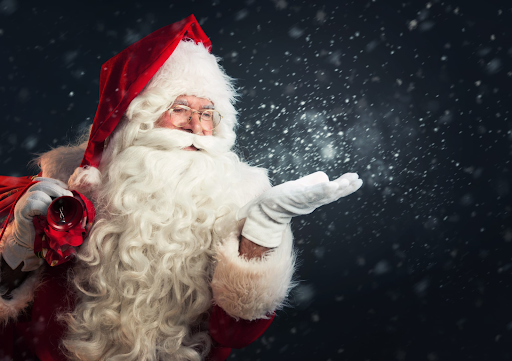
The infamous Santa Claus has existed for hundreds of years – continuously spreading Christmas spirit and making millions of children’s Christmas mornings special. Old Saint Nick relies on his magic, elves, and reindeer to make and deliver each present on Christmas Eve.
But what if he was stripped of his Christmas magic? Would Santa still be able to complete his trip around the world in less than 24 hours, or would kids end up missing out on their presents “From: Santa”?
Flight Logistics
In order to complete his deliveries, Santa needs to make the most of his 24 hours. By utilizing time zones to his advantage, he is able to turn a 24 hour journey into 31 hours.
According to UNICEF data, as of 2024, there are roughly 2.4 billion children (under 18) in the world. Roughly 30% of the world practices Christianity, and therefore celebrates Christmas. That would mean 720 million children celebrate Christmas each year.
If Santa is to deliver each and every one of them presents, he would need to get through 6451.613 houses every second. But assuming each home has an average of 2.5 kids per two parents, he would only need to deliver to 2580.645 houses per second, which is much more reasonable.
Accounting for the rural clusters and urban gaps, let’s pretend on average, the distance between each house is 0.1 miles. This is a very inaccurate approximation, as it does not account for barren deserts, jungles, forests, and most importantly, oceans. But by using this hypothetical, it’s concluded that Santa needs to travel at 258 miles (415211 meters) per second – roughly 1211 times the speed of sound.
Santa’s Sleigh
Santa’s sleigh is already dripping in Christmas magic, but is its magic the only way it can protect Santa, the presents, and itself from the drastic flying conditions? At the speed in which Santa is traveling, his sleigh would need to withstand 66,000℉ (significantly hotter than the surface of the sun).
By using materials with the highest melting points known to man, and a little help from his North Pole magic, Santa’s sleigh would be the strongest (and fastest) form of transportation ever created. Hafnium Carbide and Tantalum Carbide hold the highest melting points of any compound at 7,232°F, and would prove to be the best physical substance available.
The Reindeer
While the sleigh is figured out and everything inside is protected, the reindeer have yet to be accounted for. At these high speeds and temperatures, there is no possible way for the reindeer to survive, let alone fly, without completely using Santa’s magic.
Some things are easier to reason out and explain using math or science, but there come times when faith and imagination must be brought into the equation. In this scenario, there is no other way to explain how the nine reindeer survive and fly at such high speeds. But some things must be left up to the imagination, and the magic of Santa himself.
Present Deliveries
Once Santa, his sleigh, and his reindeer survive the journey to each house, he has less than 387.5 microseconds to drop off presents, fill the stockings, eat or drink any treats left for him, and make it back to his sleigh. Obviously, to the average person, this is impossible – but to someone like The Flash, from DC Comics, it’s light work.
If we assume Santa’s magic allows him to travel at superhuman speed, this would also explain why no one can ever actually catch or spot him. A fireproof suit would also protect him from catching fire due to his physical speed in the homes, the speed he travels in his sleigh, and when that one family forgets to turn their fireplace off before bed.
Naughty and Nice List
Determining which kids end up on the nice and naughty list could be arguably the easiest, or hardest job Santa faces. What dictates which actions are naughty and which are nice? And is Santa the kind of man to completely rid a young child of the joy and whimsy of Christmas simply because they misbehaved?
We know the nice and naughty list is just propaganda that Santa and parents have worked together to convince children to behave. The idea of this list forces children to imagine the possibility of making the naughty list due to bad behavior, and not getting to experience the entirety of Christmas like everyone else.
Now this is just a theory, but it seems that Santa has much more important things to do than evaluating the actions of 720 million children, and parents may use this to their advantage.
The Elf’s Workload
The famous elves run Santa’s workshop, prepare children’s toys, wrap presents, and prep from the big night in any way necessary. This could include caring for the reindeer, polishing the sleigh, or even helping Mrs. Claus manage production.
Without the elves, Christmas wouldn’t be the same. They allow for each and every child to get the gift they’ve been waiting for, and keep the North Pole under control all year round.
The Other 364 Days of the Year
The real question is, what is Santa doing the rest of the year? Christmas Eve is the big night, so we can assume Santa needs a long and peaceful vacation with Mrs. Claus after spending 31 hours straight going 258 miles per second.
Throughout the year, Santa needs to keep track of what children mention or want to start preparing for Christmas Eve once again. If Santa relied strictly on Christmas lists for children’s presents (which most kids won’t send) that would still only leave him and the elves less than one month to prepare. By keeping track of the kids’ wants throughout the year, the elves can keep production and productivity up in the slower months.
Santa’s work never stops, and neither does the spirit of Christmas. Christmas is something billions of people look forward to each and every year, not only because of Santa Claus, but because of how it brings families together. Santa provides something a little magical to Christmas, but the love of those who celebrate keep his traditions alive.

It makes my day better when I park well.
Leave a Reply