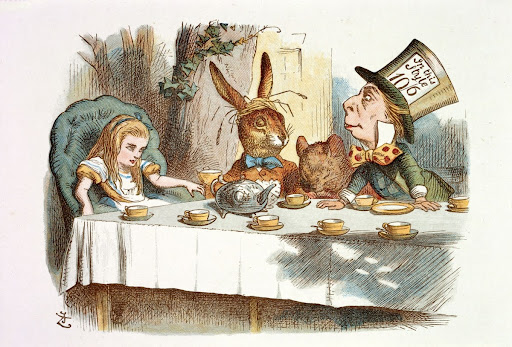
Many of us are familiar with the story of Alice in Wonderland. A curious girl stumbles down a rabbit hole into a world of complete nonsense, where she then attempts to find her way home.
However, many people are unfamiliar with how the book’s author, Charles Dogeson, more commonly known by his publishing name, Lewis Carroll, used the book as a cultural bomb disguised as fantasy to expose some of the darkest truths of the Victorian era.
Carroll was a mathematician at the University of Oxford in England, where he became close friends with many of his students. One of these particular students was Alice Little, the inspiration for the book’s Alice, giving the book to her one year as a Christmas present.
Carroll was known to spend time with young girls and did not have many friends of his own age. Carroll was also known for his photography skills for taking pictures of nude girls.
After Carroll died, his family went through his personal diary and deliberately removed entire pages — specifically the ones that cover the period of time when he was closest to Alice Little — slicing out the pages one by one, and burning them.
To finally set the record straight, the constant growing and shrinking in the book due to what Alice eats is not a reference to drugs; this was just a rumor that was started in the 60s. The truth is far darker than that.
During Carroll’s time, it was common for parents to use Lordinium, or liquid opium, for everything from headaches to quieting restless infants. The substance would stop children from crying and calm them down.
However, the drug had severe side effects. Many parents reported their children’s faces turning blue and puffing up, eventually leading to suffocation after being served too much of the poison.
How easily Alice consumes these substances mirrors exactly how casually Victorians consumed their daily dose of opium, shedding light on the disturbing practice.
The book describes the baby’s transformation into a pig in a grotesque way: “There could be no doubt that it had a very turn-up nose, much more like a snout than a real nose; also, its eyes were getting extremely small for a baby: altogether Alice did not like the look of the thing at all.”
This description would be the same given in medical records for children who took consistent doses of Lordinium.
Known commonly for his nonsensical behavior, outspoken and sometimes even rude comments, and riddles, the Mad Hatter is one of the most memorable characters of the book. With people referencing his lines such as “Why is a raven like a writing desk?” or “If you knew Time as well as I do, you wouldn’t talk about wasting it” even today.
The character of the Mad Hatter came from the expression “mad as a hatter” during the Victorian era. However, this was not just a funny Victorian expression; it described a horrific occupational disease.
The process of making hats during that time released toxic fumes into the air due to Hg(NO₃)₂ or Mercury Nitrate. Prolonged exposure leads to mercury poisoning as the hatter’s hands start to shake uncontrollably, his speech then becomes slurred, and finally, he sees hallucinations of giant rabbits in the corners of his workshops. Several days later, the hatter dies.
Everyone knew about the poisoning: the owners knew, the public knew, the government knew; yet no one did anything about it. Instead, they stood idly by as hundreds lost their lives each year.
The use of mercury in hat-making wasn’t banned until the 1940s, and only then because it was needed for military use.
Chapter 8 begins with a couple of guardsmen for the Queen of Hearts frantically “painting the roses red” because they had planted the wrong roses by accident. You may brush off this scene as nothing, but it has a much darker meaning behind it.
The scene would have been immediately recognizable to Victorian audiences at the time. The red rose was the clear symbol of the House of Lancaster, while the white rose was symbolic of the House of York.
These 2 royal houses fought the War of the Roses, which was one of the bloodiest wars in England’s history, where one could be beheaded simply for wearing the wrong color rose. 28,000 lives were lost.
The painting of the roses wasn’t just an act to appease the queen; it was a reflection on the subject’s desperate efforts to display the right political allegiance to avoid death.
“How Doth the Little Busy Bee…”
During the Victorian era, the idea of education was mindless repetition, until the words were carved into the children’s memories.
Children would recite things such as “how doth the little busy bee improve each shining hour,” not having any idea what they were saying, but it did not matter since questions were forbidden.
Kids were seen as entertainment to adults. When they were in school, instead of actually learning anything, teachers taught students these rhymes that they could recite to adults to “show off their knowledge.
Alice starts out as one of these children; however, as she travels to Wonderland these recitations turn to nonsense.
She realizes that without knowledge, she doesn’t know who she is anymore.
Alice in Wonderland is timeless because it addresses people from all walks of life. Children see a fun story of adventure, while adults recognize the social satire; however, historians see something else entirely: a coded map of Victorian England’s darkest secrets.
Carroll didn’t write a children’s book; he wrote an expose disguised just enough to slip into nurseries all around the world.
My best friends make my day better.
Leave a Reply