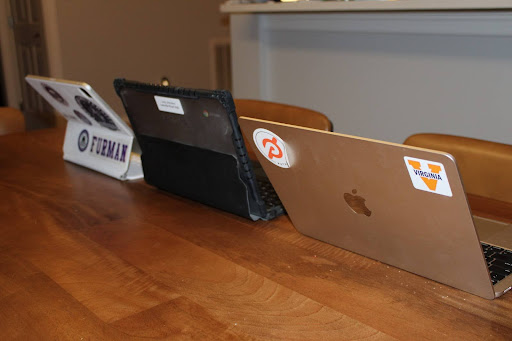
The current WCPSS policy on Chromebooks states that students are “required to use their WCPSS-assigned Chromebooks unless there have been prior arrangements” to make acceptances. However, acceptances aren’t being made.
There are many people who have accommodation plans in Wake County. From IEPs to 504s, these tools are essential to help students succeed. Even so, many students use things that aren’t necessarily included in their accommodation plan.
The rigid Chromebook policy not only impacts students with ADHD, Autism, and Dyslexia but also underscores broader systemic challenges. It creates barriers for those who need specific tools outside of standard devices, highlighting the need for a more flexible approach to accommodations.
ADHD
ADHD or Attention-Deficit Hyperactivity Disorder–put in simple terms–is a condition that affects how people pay attention, stay still, and control their actions. These ongoing difficulties constantly disrupt a person’s everyday life.
I have been struggling with ADHD my whole life. However, certain tools, such as my headphones and personal device, make the average school day so much easier for me.
It’s hard to explain to a neurotypical person what trying to focus is like in the everyday classroom for someone who has ADHD. Think of it this way: imagine you’re walking on a tightrope carrying a bunch of fragile things. You try to get to the other side of the rope, but it’s not that simple. There are distractions all around you, and dozens of people are constantly trying to push you off, attempting to veer you from your course.
Then all of a sudden you put on a pair of headphones and you are shielded from all other distractions, able to think clearly.
Having a more manageable personal device allows individuals with ADHD to organize their computer in a way that aligns with their thinking style. This flexibility helps them spread out their tasks and information effectively, rather than being restricted by the limitations of Chromebooks.
Dyslexia
Dyslexia is one that people have a harder time understanding. To officially clarify, dyslexia is a language-based learning disability that makes reading, writing, and spelling much harder for someone, even if they are smart, motivated, and have had proper education.
It often looks like difficulty spelling words, switching words, mistaking one word for another when reading out loud, confusing letters with similar shapes, mixing up the position of sounds in a word, etc.
I have a special read-aloud app called Speechify, which allows me to upload any document and have it read to me. I also have Audible for read-aloud books, and I have a special dyslexic font, known as Open Dyslexic, on my device, which greatly increases my reading pace.
These things are not available on a regular school Chromebook. Yes, Chromebooks have read-aloud, but it’s an extension that’s very glitchy and has unengaging voices — thus, why students who also have ADHD tend to space out and not pay attention.
Furthermore, students cannot wait until they get home to use their own devices. What about the times during class when you have a very limited time to read a document and then discuss it, or what if the student has a lot of afterschool activities that day and they need to get their work done? They cannot wait until the end of the day, they have work to get done.
Autism
Autism Spectrum Disorder, or ASD at its face value, is a developmental condition that affects how a person interacts with others, communicates, and learns.
The use of personal devices allows autistic students to download special apps to help with the average school day, such as Proloquo2Go which helps these students with communication, Choiceworks to assist them with visual schedules and routines, or AutiSpark which includes many educational games. These same appliances are not always available on Chromebooks, meaning that students’ needs are not always met.
School-issued Chromebooks have many restrictions and many different extensions are blocked — which in some cases can be a positive thing; however, it can also be a negative thing for students who need certain accommodations.
Headphones are also extremely helpful for students with autism, whether it be level 1 (high-functioning) or level 3 (low-functioning). They not only allow students to focus better with music, but when they become overstimulated by everything around them, their headphones allow them to separate themselves from the situation.
Students with level 3 autism have been able to receive accommodations, while people with level 1 or 2 go unseen or unnoticed with their need for accommodations and advocacy.
By recognizing the importance of personalized tools and resources, we can create a more inclusive educational environment that empowers all learners to thrive. Embracing flexibility not only supports individual learning styles but also fosters a culture of understanding and acceptance within our schools.

My best friends make my day better.
Leave a Reply